Blacksheep Mind Get the book, $12

A Blacksheep Mind web book · Writing for social media

You’d rather be ignored than sound like clickbait.

There’s a third way: start with something true, and put it first. Five ways to write a first line from your own business, a check so it never promises more than the post gives, and a fair way to test two openings. For owners who post, and the person who does their posts.

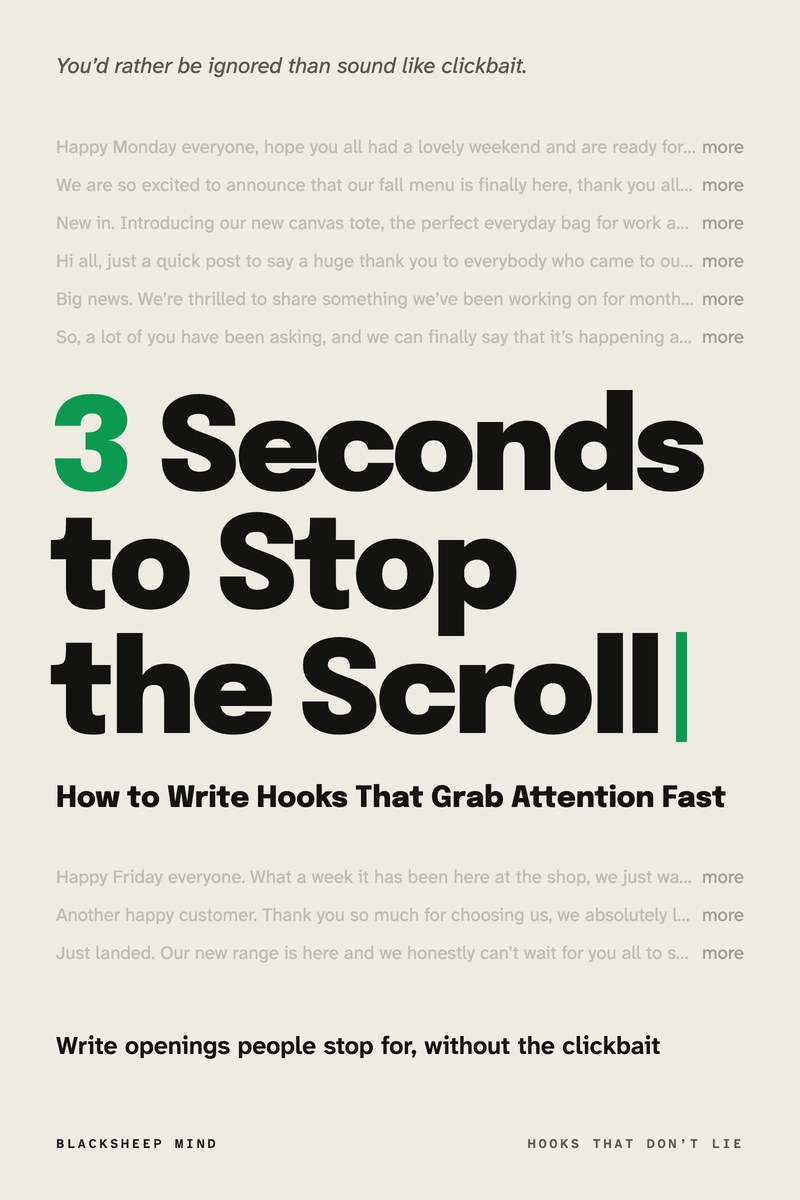
3 Seconds to Stop the Scroll: How to Write Hooks That Grab Attention Fast. Write openings people stop for, without the clickbait.

The cover of 3 Seconds to Stop the Scroll: How to Write Hooks That Grab Attention Fast.
Read it online, or download the PDF to keep or print. Nothing is posted to you.
Chapters
9
Tools
3
Reading
55 min
Price
$12
Get the book, $12

Read it tonight on your phone or laptop. One price, no upsells. No refunds: you get the whole book straight away.

The moment

The best line was the third one. Nobody got that far.

  • You checked the post twice. Four likes, and one of them was your sister.
  • A regular asks at the counter about the thing you wrote in line three.
  • Your video opens with “Hi everyone” and a slow walk to the counter.
  • You’d never say “You won’t believe” to a customer, and every hook list starts there.

So you keep the polite version and blame the algorithm. There’s a third way. Open your last caption, find the line a customer would care about, and move it to the top. That’s the first chapter, and it takes a few minutes.

What’s inside

Nine chapters, in the order you’ll use them

  1. 01

    Cut the Warm-Up

    Most posts already have a hook. It’s in line two or three, after the hello. Move it to the top.

  2. 02

    Where Your 3 Seconds Are

    A post’s first line, a video’s first 3 seconds, an ad’s first words and an email’s subject line, and the few rules each one has.

  3. 03

    Start With the Question They Keep Asking

    The questions customers ask you every week are first lines already written, in their words.

  4. 04

    Start With a Mistake

    One you made, or one you fix for customers every week, said kindly, with the fix in the next line.

  5. 05

    Start With a Number From Your Work

    Hours, layers, tries, orders. A number you counted says more than an adjective you chose.

  6. 06

    Start With the Before

    The mess, the stain, the chair on the curb. Show it first, honestly, then get to the after.

  7. 07

    Start With What You Actually Think

    The thing you say at the counter that surprises people. Nobody else can copy it.

  8. 08

    Keep the Promise Your Hook Makes

    The hook check, to run before anything goes out, so a first line never says more than the post gives.

  9. 09

    Let Your Own Posts Decide

    Test two openings fairly, with the numbers your app already shows you, and believe it the third time.

Plus a short introduction and a closing chapter where you write 10 openings of your own in one sitting. 9 chapters, about 55 minutes to read.

A page from the book

Curious is fine. Lying isn’t.

The Check · from the book, word for word

Keep the Promise Your Hook Makes

A case

Happy Brithday

Anjali sells greeting cards online from her spare room. One Tuesday she opened a box from the printer: 200 birthday cards that said “Happy Brithday”. The typo was hers. She’d checked the design three times and read what she expected to see. Reprinting held up that week’s orders.

For the post about the delay, she copied an opening from a free list: “You won’t believe what happened to our last order...” It got more views than usual. The first comment was “that’s it?”, and a few people unfollowed that week.

Her first reflex was to give up on hooks and go back to “New designs just dropped”. Instead, she ran the hook check. The post failed two lines: the opening hid what it was about, and it promised more than the post gave.

She rewrote it from what had happened: “We printed 200 birthday cards that say Happy Brithday. Here’s what we’re doing with them.” The picture showed the typo up close. Orders would ship Friday, and the misprints were $1 each.

It got fewer views than the first post, but more comments and saves, and 37 misprinted cards sold that week.

What to say
Instead of

“You won’t believe what happened in the shop today...”

Try

“A customer brought back a teapot she bought from us in 2009. Still pours.”

Instead of

“Stop scrolling. This is your sign to book that appointment.”

Try

“Three appointments left this Saturday, all in the morning.”
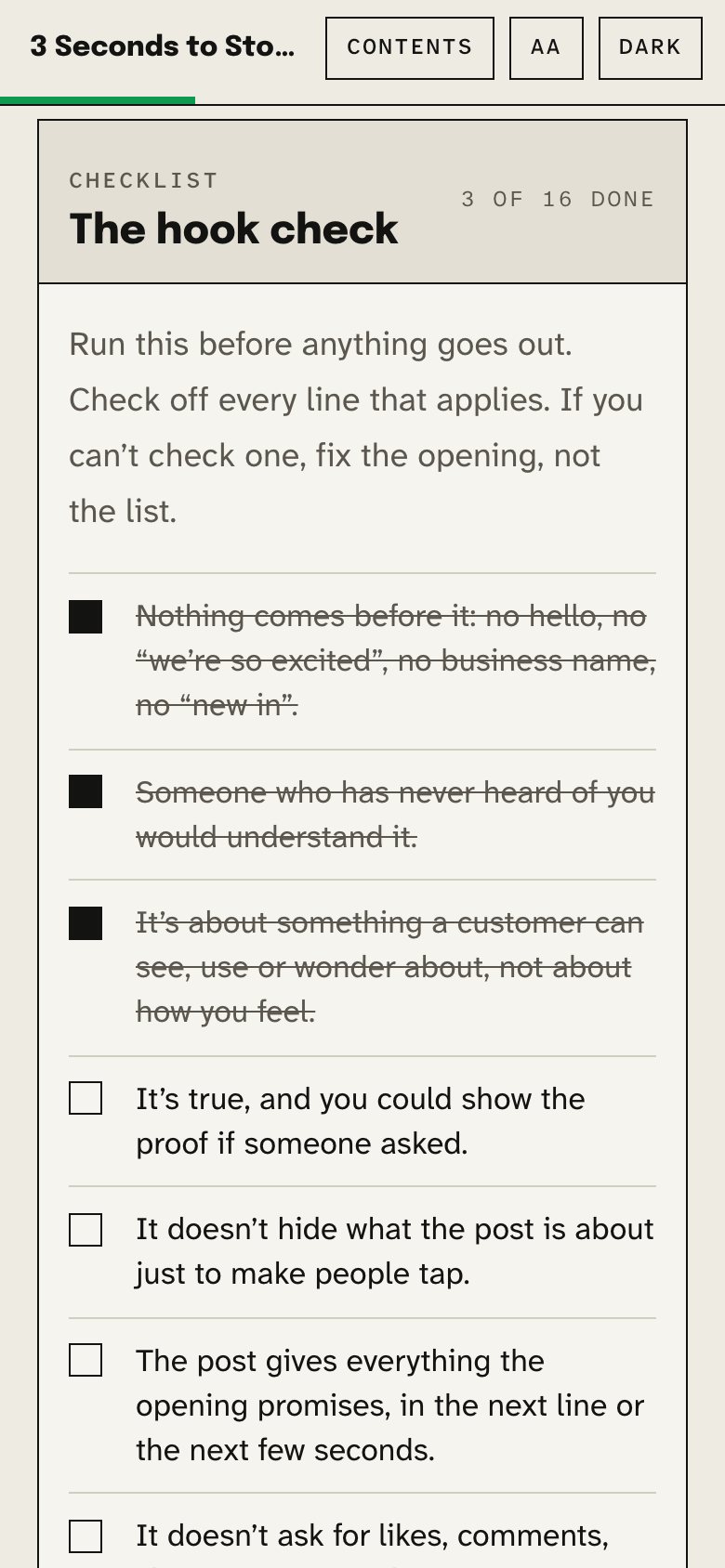
The hook check in the web book, on a phone, with three items ticked.
The hook check, ticked off before you post
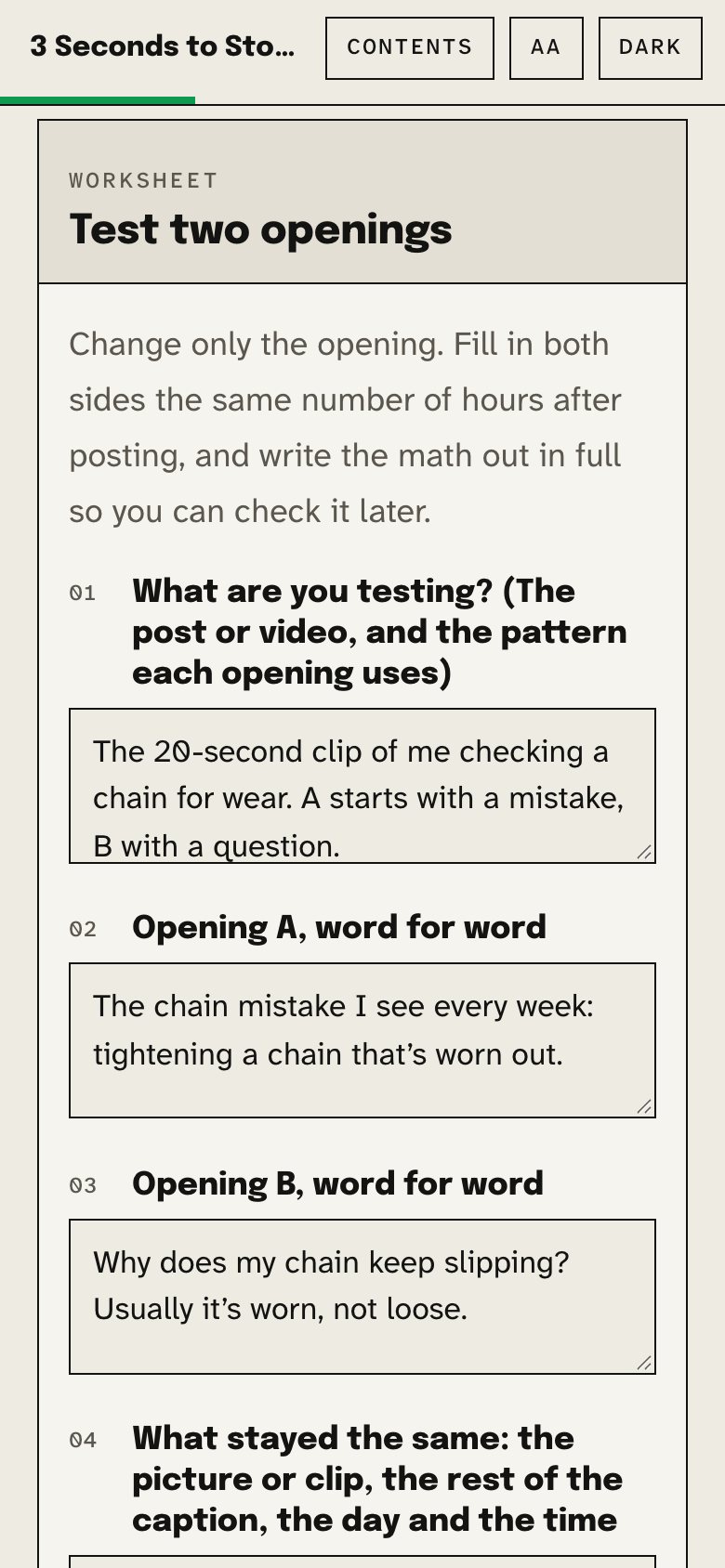
The test two openings worksheet in the web book, on a phone, with a made-up example filled in.
Two openings for one video, with a made-up example

The tools

Three things to keep open while you write

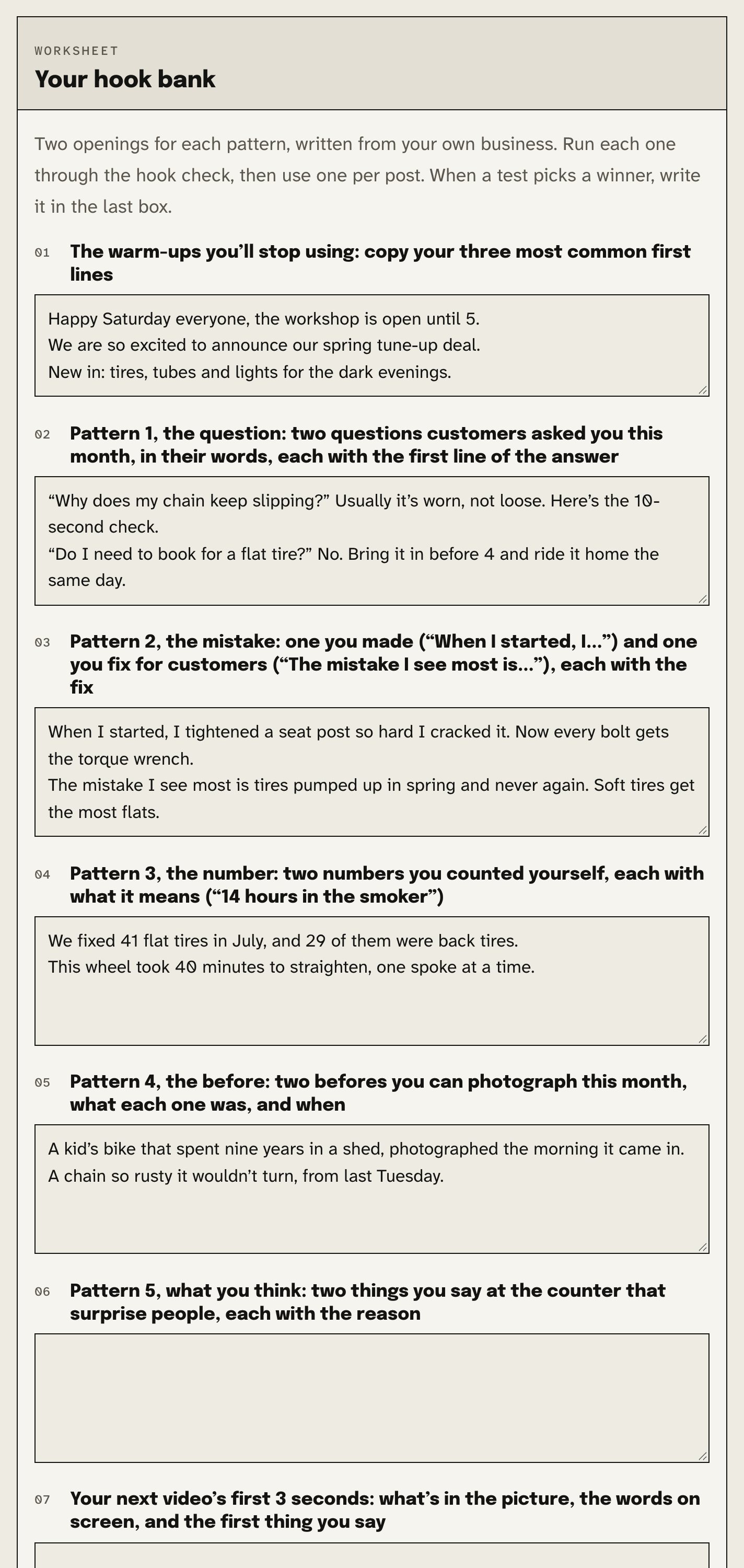
  • WorksheetYour hook bankTwo openings for each of the five ways to start, from your own business, plus your next video, ad and email. About 30 minutes.
  • ChecklistThe hook checkEvery line to tick before a post, an ad or an email goes out, so the opening is true and the post keeps its promise.
  • WorksheetTest two openingsSame post, two first lines. The same numbers for both, the math written out, and what goes into your hook bank.
The hook bank worksheet in the web book, part filled in with a made-up example.
The hook bank, with a made-up example filled in

Who it’s for

For whoever writes the first line

For you if

  • You run a salon, cafe, bakery, gym, shop, trade or small online store, and you post most weeks.
  • You do the posts for someone else’s business, and you want openings that suit it.
  • You’ve been told you need a hook, and every one you find sounds like clickbait.
  • Your posts start with hello, “We are so excited” or the name of the product.

Not for you if

  • You want tricks to beat the algorithm, or a promise of views. Nobody can honestly promise those.
  • You want help buying ads, or filming and editing. This book covers the first line and the first 3 seconds, not the rest.
  • You want a list of 500 hooks to copy. You’ll write 10 of your own instead.
Get the book, $12

5 ways to start · 3 tools · read tonight

Your questions

Before you buy

I’ve seen free hook lists. Why pay?

Lists give you other people’s openings, in a creator’s voice. This book helps you write your own, from your own business, and check that they’re honest. You fill in a hook bank as you go.

Will this get me more views or followers?

No one can honestly promise that, and this book won’t. It helps more of the people who already see your posts stop and read, and it shows you how to tell whether an opening is working.

My business is boring. Will it work for a plumber or a bookkeeper?

Yes. The five ways to start come from things every business has: questions customers ask, mistakes, numbers from the work, the before and after, and what you think. Some of the cases are trades.

I don’t want to be on camera. Is it still for me?

Yes. Most of the book is about words: the first line of a post, an ad and an email. For videos, it covers what’s in the picture and the words on screen too, so you can start one without showing your face.

Is it only about Instagram?

No. It works on any app where people scroll, and in your emails. Where an app shows you useful numbers, the book says so in general terms.

How long does it take?

About 55 minutes to read. Your first 10 openings take about 30 minutes, and a test takes two posts and a few minutes to compare.

Is it a PDF?

You get both. Read it online on your phone or laptop, where the worksheets save as you type, or download the PDF to keep or print. In the PDF, the worksheets have lines to fill in by pen.

3 Seconds to Stop the Scroll: How to Write Hooks That Grab Attention Fast

Read it tonight. Rewrite tomorrow’s first line.

$12one price, no upsells
Get the book, $12

Read it online, or download the PDF to keep or print. Nothing is posted to you. No refunds: you get the whole book straight away.